




The federal government plans to spend Rwf7.8 trillion within the 2026/27 fiscal yr, a rise of Rwf844.2 billion from the revised Rwf6.9 trillion price range for 2025/26.
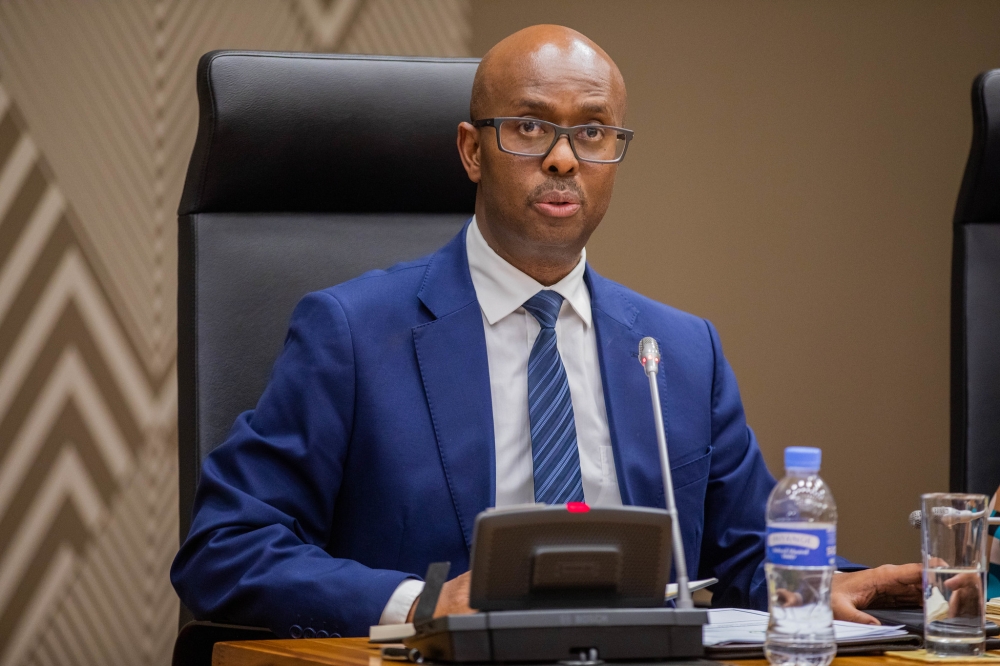
This was revealed by the Minister of Finance and Financial Planning Yusuf Murangwa whereas presenting the price range framework paper to a joint sitting of Parliament on Monday, Might 11.
“Whole assets for the 2026/27 fiscal yr comprise home revenues of Rwf5,273.8 billion,” Murangwa stated in his price range speech, whereas highlighting the federal government’s medium-term spending priorities.
ALSO READ: How Rwanda plans to fund, spend Rwf7tn price range for 2025/26
The minister stated the proposed price range shall be financed via a mix of home revenues, grants and exterior loans.
Home revenues embrace Rwf4,429.1 billion from tax revenues, Rwf582.4 billion from different revenues, Rwf123.6 billion from acquisition of economic belongings and Rwf138.8 billion from home financing.
Murangwa added that exterior grants are estimated at Rwf548.3 billion whereas exterior loans are anticipated to quantity to Rwf1,974.1 billion.
On the expenditure facet, recurrent spending, together with salaries and operational prices, is projected at Rwf4,775.1 billion, whereas Rwf3,021.1 billion will go to improvement initiatives and authorities investments, together with coverage lending.
ALSO READ: Govt revises down 2025/2026 fiscal price range by Rwf80bn
“Funds allotted to the event price range and authorities funding, together with coverage lending, fairness and funding, will quantity to Rwf3,021.1 billion,” he stated.
Murangwa advised lawmakers that the price range priorities have been agreed upon following consultations between the Ministry of Finance and Financial Planning and authorities establishments, with allocations aligned to the three pillars of the Second Nationwide Technique for Transformation (NST2).
Agriculture, infrastructure
Underneath the financial transformation pillar, the federal government plans to prioritise agriculture, infrastructure, power, ICT, personal sector improvement and environmental safety.
In agriculture, deliberate interventions embrace well timed distribution of fertilisers and improved seeds, growth of irrigation schemes, development of put up harvest storage infrastructure, livestock vaccination and synthetic insemination programmes, in addition to growth of crop and livestock insurance coverage.
ALSO READ: Specialists push for jobs, power safety, and resilience in 2026/27 price range
Murangwa stated the federal government additionally plans to strengthen strategic grain reserves and enhance farmers’ entry to finance.
Infrastructure initiatives anticipated to obtain funding embrace the growth of feeder roads and paved nationwide roads, enchancment of public transport programs, and development of the expanded street resulting in the brand new Kigali Worldwide Airport.
Within the power sector, the federal government plans to proceed investing in electrical energy era initiatives, together with the Nyabarongo II hydropower plant, whereas additionally increasing electrical energy entry to households and productive sectors.
The minister stated the federal government would additionally proceed creating Kigali Innovation Metropolis, promote convention tourism, help skilled mining actions, and merge district SACCOs as a part of plans to determine a Cooperative Financial institution.
ALSO READ: SACCOs to be merged into single Cooperative Financial institution by 2026
Within the ICT sector, the federal government plans to increase implementation of e-services in sectors together with justice, agriculture, public finance administration and social safety, whereas persevering with implementation of the digital nationwide identification system.
Environmental safety initiatives embrace rehabilitation of Kigali wetlands, restoration of degraded forests, conservation actions round Volcanoes Nationwide Park, and acquisition of climate radar tools to strengthen forecasting companies.
Schooling, healthcare
Underneath the social transformation pillar, the federal government plans to put money into training, healthcare, social safety, youth improvement, and sports activities.
Deliberate interventions in training embrace recruitment of academics, provision of educating supplies, growth of college feeding programmes, and development of lecture rooms and TVET colleges in numerous districts.
The federal government additionally plans to finish development of the veterinary drugs college and educating hospital on the College of Rwanda’s Nyagatare campus.
In healthcare, precedence initiatives embrace growth of Muhororo, Kabgayi and Ruhengeri hospitals, continued development works at Kibagabaga Hospital, and coaching of well being employees.
The price range additionally gives for continued help to the community-based medical health insurance scheme, generally generally known as Mutuelle de Sante, and interventions aimed toward decreasing youngster stunting.
Funds underneath social safety programmes will help weak households via VUP schemes, enhance the Social Registry system, and help households affected by disasters or dwelling in high-risk zones.
The price range framework additional outlines help for sports activities expertise improvement and youth programmes similar to YouthConnekt and Artwork Rwanda Ubuhanzi.
International financial pressures
Murangwa stated the draft price range framework was ready amid continued international financial uncertainty linked to conflicts within the Center East.
“This draft price range framework for 2026/2027 has been ready at a time when each the worldwide economic system and the nationwide economic system proceed to face challenges arising from the battle within the Center East,” he stated.
In line with the minister, the disaster has contributed to rising costs of petroleum merchandise, gasoline and fertilisers, in addition to disruptions in international provide chains.
“These challenges have been taken under consideration in designing the financial measures included on this draft state price range framework,” he stated, including that the federal government would proceed monitoring the scenario and take applicable measures the place needed.
In the course of the parliamentary session, lawmakers raised considerations over proposed allocations to agriculture and street infrastructure.
MP Minani Bizimana questioned what he described as lowered funding for agriculture regardless of the sector’s significance to the economic system.
“There’s a discount in agriculture. Why is such an necessary sector set to expertise the discount?” he requested.
The legislator additionally questioned the restricted help for staple meals similar to bananas and candy potatoes, in contrast with the stronger give attention to Irish potatoes underneath improved seed programmes.
“These crops complement one another,” he added.
Bizimana additional referred to as consideration to the deteriorating state of the Bugarama Kamembe street and requested the federal government what plans have been in place for its rehabilitation.
Responding to the considerations, Murangwa stated some allocations have been nonetheless underneath evaluation and indicated that discussions with the Ministry of Agriculture and Animal Sources would proceed concerning crops that lawmakers felt wanted extra help.
“We’ll discuss with the agriculture ministry and have a look at what to do. I additionally agree that these crops shouldn't be left behind,” the minister stated.


